- Measure the capital. Pull the market value of equity (E) and of debt (D), then add the two for total capital (V).
- Find the weights. Divide E by V, then D by V. Those two numbers say how much of the funding comes from each side.
- Estimate the cost of equity (Re). Most analysts reach for the CAPM model here, building Re out of a risk-free rate, the stock’s beta, and the expected market return.
- Estimate the cost of debt (Rd). Take the average rate on the company’s loans and bonds, then trim it with (1 − Tc) for the tax shield.
- Combine them. Multiply each cost by its weight, add the two, and there is your WACC.
What Is WACC in Finance?

7 min to read
Updated on 23 Jun 2026
Money is never free. If a company wants to build a new plant or buy out a rival, it has to find the cash somewhere, and whoever supplies it expects something back. Shareholders want returns. Lenders want interest. Tally the cost of every funding source, scale each by how heavily the company relies on it, and what falls out is WACC. Once it is on your radar you spot it everywhere, in valuations, in investment cases, in the call to green-light a project or kill it.
Article navigation
What Is WACC?
Most people new to finance meet the acronym long before they pause to ask what is wacc and what it really tells them. Spelled out, it is the weighted average cost of capital. Drop the textbook tone and the idea is plain: roughly what a business pays for all the money keeping it running, counting both shareholder funds and borrowed funds.
Practice Before You Invest
Theory only gets you so far. Put these ideas through a no-pressure practice account, 100+ markets, virtual funds, nothing to lose while you find your feet.
Why “weighted”? Because hardly any business runs on equity alone or debt alone. They mix the two. WACC does not just take a flat average of the costs. It scales each one to match its share of the total funding, then compresses the whole thing into a single percentage.
Boil what is wacc down to a single line and it is the smallest return a company can earn on its projects and still leave both lenders and shareholders satisfied. Slip under that mark and value leaks away, even while the income statement is still printing a profit.
Picture it as the rent a company pays on every dollar it puts to work. Some of those dollars come from owners, some from lenders, and each one charges its own rate. WACC is simply the blended bill that lands at the end of the month.
Who actually bothers with it? Analysts putting a price on companies. Finance teams choosing which projects get funded. Investors checking whether a business earns back more than it costs to run. You may never work one out yourself, yet you keep meeting the result anyway, tucked inside the price targets and ratings you read.
This kind of thing lands better once you can actually watch markets put a price on risk, instead of only reading about it.
A trading demo account makes that simple. You get to watch how borrowing costs, expected returns and live prices feed off one another, all on virtual funds, none of it out of your own pocket.
WACC Formula
You cannot really pin down what is wacc in finance without facing the formula head on. Do not let it scare you off, it behaves far better than it reads:
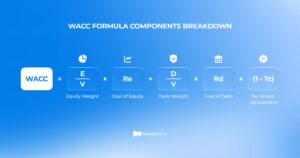
WACC = (E/V) × Re + (D/V) × Rd × (1 − Tc)
Six symbols, that is it. A quick translation of each:
| Symbol | What It Means |
|---|---|
| E | Market value of equity, what all the company’s shares are collectively worth. |
| D | Market value of debt, the full amount the company owes across its borrowing. |
| V | Total capital, which is just E and D combined. |
| Re | Cost of equity, the return shareholders demand for the risk they carry. |
| Rd | Cost of debt, the effective interest the company pays on what it borrows. |
| Tc | Corporate tax rate, which quietly trims the true cost of that debt. |
That (1 − Tc) tail is the tax shield, and it pulls more weight than you would guess. Interest payments are tax-deductible, so the real cost of borrowing lands below the stated rate. Dividends to shareholders earn no such favor. That is a big part of why debt tends to undercut equity on cost, and why a firm carrying no debt at all is not automatically the savvy one. A measured dose of borrowing can drag the entire cost of capital lower.
Risk Disclaimer: Trading involves significant risk of capital loss. This article is for educational purposes only and does not constitute financial advice. Always conduct independent research and consider your risk tolerance before making any trading decisions.
How to Calculate WACC
Figuring out what is the wacc for a given company is basically a five-step routine. The arithmetic is easy. Getting honest inputs is the hard bit.
Nail the inputs and the sum takes seconds. The estimates behind those inputs are where analysts actually earn their keep.
WACC Calculation Example
One quick reminder of what does wacc stand for, weighted average cost of capital, and then straight to the numbers. Picture a firm funded by 600 million dollars of equity and 400 million of debt. Total capital, 1 billion. The inputs:
- Cost of equity (Re): 9%
- Cost of debt (Rd): 5%
- Corporate tax rate (Tc): 25%
Start with the weights. Equity is 600 / 1000, so 0.6. Debt is 400 / 1000, so 0.4. Drop it all into the formula:
WACC = (0.6 × 9%) + (0.4 × 5% × 0.75)
WACC = 5.4% + 1.5%
WACC = 6.9%
Read that as a threshold. A new project has to clear 6.9% just to be worth doing. A 6% return sounds perfectly fine on its own, yet here it quietly leaves shareholders and lenders worse off than before.
The mix does a lot of the work here. Lean harder on cheap, tax-shielded debt and the WACC slides down, which lowers the bar for every project. Lean too hard and lenders get nervous, rates climb, and the cost creeps back up. Finding the spot between those two pressures is half of what corporate finance teams do all day.
Why WACC Matters
Knowing what is the wacc formula is one thing. Watching where the number actually bites is another. The same three uses keep resurfacing in real work.
Valuation comes first. In a discounted cash flow (DCF) model, WACC is the rate that shrinks future cash flows back to what they are worth today. Lower the rate and the valuation jumps. Raise it and the valuation sinks. That is how two analysts can run the same cash flows and still end up miles apart, they never agreed on the rate.
Then there are project decisions. Companies use WACC as a hurdle. Beat it, and a project is worth chasing. Miss it, and the project chips value away no matter how good the pitch sounded. The third use is the capital question itself, weighing debt against equity to decide how much of each the company should carry.
Back to our 6.9% company for a moment. Two projects on the table, one projected at 8%, the other at 5%. The 8% project clears the bar and builds value. The 5% one turns a profit and still destroys value, because it never covers the cost of its own funding. On the surface both look like wins. Only the WACC flags one of them as a mistake, the kind of trap that reads like a gain right up until you run the arithmetic.
Limitations of WACC
For all its uses, WACC stands on a stack of estimates, and that is its weak spot. It is also why there is never a tidy answer to what is a good wacc. Change who does the math and the inputs change with them.
The cost of equity is the softest input by a mile. It usually falls out of CAPM, which leans on beta and an assumed market return, both closer to guess than fact. Nudge them a little and the final WACC moves with them. The formula also pretends a company keeps the same debt-to-equity mix forever, which almost never happens.
Other gaps pile up too. Market values move daily, so any WACC is really just a snapshot in time. The formula slaps a single company-wide rate onto every project, even though a risky new bet and a steady core business plainly do not carry the same risk. And for a private company with no share price to point at, getting an accurate figure turns awkward fast.
There is a timing catch as well. The number leans on today’s market values and rates, so a couple of rate moves can hand you a very different WACC next quarter, even if nothing about the business changed. Best to treat it as an educated estimate, not gospel, and lean on a few other checks before trusting whatever valuation sits on top of it.
FAQ
How is WACC used in valuation?
Within a discounted cash flow (DCF) model, WACC plays the role of discount rate. It drags future cash flows back to present value, so a smaller WACC lifts the valuation and a bigger one knocks it down. The effect is strong enough that most analysts publish a range rather than insist on one precise figure.
Why Is WACC Important?
It marks the line a company has to get past. As a hurdle rate it shows managers which projects add value and which slowly eat it, and it shows investors whether a business earns back more than its funding costs. Profit on its own ignores that cost, which is exactly how a company can look profitable and still be a weak investment.
What Is a Good WACC?
No one number fits every case. A healthy WACC sits low for its sector and stays under the returns the company can realistically earn. Mature businesses often land in the high single digits, while riskier, fast-growing names tend to push into the low double digits. Good only ever means good compared with the other options and the risk on the table.
About the author :
Data
Sign up for more like this
Customize your newsfeed with content you're actually interested in — get up-to-date personalized newsletter in your inbox.

Your comment
Comments are pre-moderated to ensure they comply with our blog guidelines.