- Year 1: 1,000 / 1.10 = 909
- Year 2: 1,200 / 1.21 = 992
- Year 3: 1,400 / 1.331 = 1,052
Understanding Intrinsic Value in Investing

6 min to read
Updated on 25 Jun 2026
The price on a screen and what something is actually worth are two different numbers, and in markets they rarely line up. A stock might trade at 50 dollars while the business behind it is worth far more, or far less. Spotting that gap before the rest of the crowd does is the core of fundamental investing.
What Is Intrinsic Value?
At its core, intrinsic value is what an asset is genuinely worth, judged by its fundamentals rather than its current price tag. Think cash flows, assets, earnings power, growth, the things that actually build value over time. A market price jumps around on headlines and mood swings. The real worth underneath moves at a slower pace, anchored to the company doing the actual work. Once you can put a number on that worth, you quit guessing whether something is cheap or pricey and start measuring it.
Put Theory Into Practice
Want to see how price and value drift apart in real markets? Open a free demo account and trade 100+ assets with virtual funds.
Numbers on a page only take you so far. Watching them play out in a live market is what makes the idea actually stick.
A demo trading account lets you track how prices move against your own estimates of worth, using virtual funds with no risk to your capital.
Think of it like appraising a house. The asking price is one thing, but a careful buyer adds up the lot, the build quality, the neighborhood, and the rent it could fetch, then decides what the place is truly worth. Stocks and other assets work the same way, just with different inputs.
Why Intrinsic Value Matters for Investors
A textbook intrinsic value definition is easy to memorize. Why it matters is simpler: it hands you a yardstick. Without one, you are just reacting, piling in because a chart looks thrilling and bailing the second it turns ugly. With a worth estimate in hand, the question gets sharper: is this thing changing hands for less than it deserves, or more? That single comparison is the bedrock of value investing and most honest fundamental work.
New to fundamentals? The pocket option tutorial walks you through reading a chart, placing a trade, and sizing a position before you put real money on the table.
How to Calculate Intrinsic Value: Formula and Example
Time to get hands-on with what is intrinsic value, meaning the math itself. The most common route is the discounted cash flow method, usually shortened to DCF. Its whole premise: an asset is worth the total cash it will hand back over the years ahead, dialed down for the plain truth that a dollar arriving later counts for less than one in your pocket today. On paper, that reads as:
Intrinsic Value = CF₁ ÷ (1 + r)¹ + CF₂ ÷ (1 + r)² + … + CFₙ ÷ (1 + r)ⁿ
Three plain-language parts. CF is the cash flow you expect in each future year. The r stands for the discount rate, basically the return you demand for taking the risk on. And n is how many years out you project. Here is a quick example. Picture a business set to throw off 1,000 dollars in free cash flow next year, then 1,200, then 1,400 in year three, with a discount rate of 10 percent:
Sum them and the opening three years come to about 2,953 dollars in present-day terms. A complete model would also fold in a figure for everything earned past year three, yet the core move stays identical: drag tomorrow’s cash back to what it is worth today.
Intrinsic Value vs Market Price
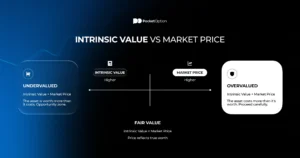
This is where the intrinsic value meaning finally clicks. Once you hold an estimate of worth, you line it up against the market price, and one of two things turns out to be true.
| Aspect | Intrinsic Value | Market Price |
|---|---|---|
| What it reflects | Estimated true worth from fundamentals | What buyers and sellers agree on right now |
| How it is set | Cash flows, assets, growth prospects | Supply, demand, and sentiment |
| How fast it moves | Slowly, alongside the business | Daily, sometimes violently |
| If worth sits above price | Asset looks undervalued | A possible buying opportunity |
| If worth sits below price | Asset looks overvalued | A reason for caution |
When your estimate of worth lands well above the market price, the asset is undervalued, the exact setup value investors hunt for. When it lands below, the asset is overvalued, and the crowd may simply be paying for hype.
Methods of Estimating Intrinsic Value
DCF gets the headlines, but it is not the only tool. Most investors blend a few methods and watch for where they agree.
- Discounted cash flow: project future cash and discount it back, the go-to for steady, cash-generating businesses.
- Relative valuation: stack ratios such as price-to-earnings beside comparable firms to catch mispricing.
- Asset-based valuation: tally everything the company holds, knock off its debts, and the leftover is your figure, best suited to asset-heavy firms.
- Dividend discount model: price a stock off the stream of dividends it is expected to pay.
Plenty of people speed all this up with an intrinsic value calculator, an online tool that runs the DCF math once you plug your numbers in. One caveat though: an intrinsic value calculator is only as honest as the numbers you hand it. Feed it shaky guesses and the output is just as shaky.
What Are the Limitations of Intrinsic Value?
For all its appeal, this is an estimate, not a fact, and a few weak spots are worth knowing. The intrinsic value formula rests entirely on inputs you have to forecast, the future cash flows, the growth rate, the discount rate. Get those wrong and the output is confidently wrong. A small change to the discount rate alone can swing the result hard. The intrinsic value formula also chokes on companies with no steady cash flows, think young startups, where there is almost nothing solid to project from. And different methods, fed the very same business, regularly spit out different numbers. None of this makes the work pointless. It just means the honest answer is a range, not one sacred figure.
Using Intrinsic Value in Value Investing
So what does intrinsic value mean for a value investor? Just about everything. The whole strategy, made famous by Benjamin Graham and later Warren Buffett, rests on one move: estimate an asset’s worth, then buy only when the market hands it to you at a clear discount. That cushion between price and worth is the margin of safety, and it is what protects you when your estimate turns out a little off, which it always does. Value investors are not trying to call next week’s price. They are buying a dollar for sixty cents and waiting for the market to come around.
Risk Disclaimer: Trading involves significant risk of capital loss. This article is for educational purposes only and does not constitute financial advice. Always conduct independent research and consider your risk tolerance before making any trading decisions.
FAQ
Can Intrinsic Value Change Over Time?
Yes, and often. It is built on assumptions about future cash flows, growth, and interest rates, and every one of those shifts. A new product, a rate hike, a soft earnings quarter, any of them can move the underlying worth. That is why investors re-run their estimates instead of calculating once and filing it away.
Why Is Intrinsic Value Different From Market Price?
The whole intrinsic value vs market price gap exists because the two answer to different forces. Worth flows from fundamentals and moves slowly. Price flows from buyers and sellers reacting to news, emotion, and momentum, so it overshoots in both directions. That gap is exactly what value investors try to exploit.
Which Method Is Most Common for Calculating Intrinsic Value?
The discounted cash flow model is the most widely used, especially for companies with predictable cash flows. Many investors pair it with relative valuation, checking ratios against peers, to sanity-check the DCF rather than trusting a single method on its own.
About the author :
Learning
Sign up for more like this
Customize your newsfeed with content you're actually interested in — get up-to-date personalized newsletter in your inbox.

Your comment
Comments are pre-moderated to ensure they comply with our blog guidelines.