- Bitcoin dominance starts sliding as capital rotates out of BTC.
- The ETH/BTC ratio climbs, with Ethereum, the largest altcoin, leading the charge.
- Altcoin trading volumes pick up across exchanges.
- The index itself pushes up toward the 75 mark.
- Bitcoin drifts sideways after a strong rally, and money goes hunting for the next move.
What Is Altcoin Season?

6 min to read
Updated on 30 Jun 2026
Crypto never climbs in a clean line. It comes in waves. Bitcoin runs first. The headlines pile up. Then, every so often, the money spills out into hundreds of smaller coins that rip higher all at once. That second wave has a name, and there is a simple index built to catch it in the act. Both are covered below, no jargon.
What Is Altcoin Season?
Altcoin season, or alt season, is a stretch where altcoins, meaning basically any crypto that is not Bitcoin, beat Bitcoin across the board. BTC stops leading. Money slides into Ethereum, Solana, and a long tail of smaller names, and they put up bigger percentage gains. Why does it move that way? A big Bitcoin run leaves profits looking for the next thing, and the faster, riskier upside of alts is where traders go looking. To check whether this rotation is actually underway, plenty of people watch the altcoin season index, a single number that sums up the whole market mood at a glance.
Trade the Next Alt Season
Want to be ready when the rotation hits? Open a free demo account and practice trading altcoins with virtual funds on 100+ assets.
Spotting a rotation on a chart and actually trading it are two very different things. Alts move fast in both directions, and the gap between a clean entry and a painful one usually comes down to the practice you put in before the move, not the scramble during it. That is the part most beginners skip, and it is the part that protects your money.
A demo trading account lets you rehearse altcoin entries and exits on live prices with virtual funds, so the real thing is not your first attempt.
What Is the Altcoin Season Index?
The Altcoin Season Index answers one question: is it altcoin season right now, or is Bitcoin still running the show? It crushes a messy market into one number from 0 to 100. Nobody can eyeball hundreds of coins at once, so the single score does the work. High reading, alts are beating Bitcoin broadly. Low reading, Bitcoin is on top. It will not pick a coin for you. It just tells you which part of the cycle you are standing in.
If placing crypto trades is still new ground, the pocket option tutorial is a fast way to get comfortable before you act on any signal.
How Does the Altcoin Season Index Work?
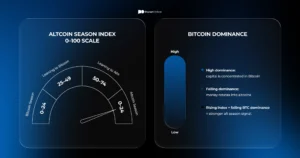
The math is simpler than it sounds. The index takes the top 50 coins by market cap, sets aside stablecoins and asset-backed tokens, and checks how each one performed against Bitcoin over the past 90 days. Then it tallies what fraction of them came out ahead of BTC. If 75 percent or more outran Bitcoin, it is officially alt season. If only a quarter or fewer pulled it off, Bitcoin is firmly in charge. Anything between those two marks is a no-mans-land.
| Index Value | Phase | What It Means |
|---|---|---|
| 75 to 100 | Altcoin Season | Most top alts are beating Bitcoin |
| 50 to 74 | Leaning to Alts | Mixed, momentum tilting toward altcoins |
| 25 to 49 | Leaning to Bitcoin | Mixed, Bitcoin holding the edge |
| 0 to 24 | Bitcoin Season | Bitcoin is outrunning most alts |
The 90-day window earns its place. It irons out one-day noise, so the score tracks a genuine trend rather than a single crazy candle.
Bitcoin Dominance and Altcoin Season
Bitcoin dominance is BTC’s share of the total crypto market cap. When dominance is high, money sits concentrated in Bitcoin. When it falls, capital is leaking out into altcoins, the classic backdrop for an alt season. The two move like a seesaw. Reading the altcoin season index current level next to Bitcoin dominance gives you a fuller picture: a falling dominance and a rising index together is a far stronger signal than either one on its own. That is exactly why seasoned traders rarely trust a single number in isolation.
There is also a rough order to how the money moves. Bitcoin tends to rally first and pull dominance up. Then profits rotate into the large-cap alts like Ethereum, then down into mid-caps, and finally into the smallest, most speculative coins right as hype peaks. Knowing where you are in that chain helps you judge whether a rotation is early and building or late and about to unwind.
Signs That Altcoin Season May Be Starting
No bell rings at the start of alt season, but a handful of signs tend to show up together. Once you grasp what is altcoin season index telling you, these get easier to read alongside it:
None of these is a guarantee on its own. Stacked together, though, they paint a much more convincing picture.
Why Altcoin Seasons Do Not Last Forever
Alt seasons burn bright, then burn out. Altcoins are smaller, thinner, and a lot more speculative than Bitcoin. The same momentum that launches them is what makes them brittle. Euphoria peaks, profit-taking starts, and capital either rotates back to Bitcoin or walks out of crypto entirely. The small coins hand back their gains fast, usually faster than they made them. History rhymes here: every cycle so far has seen alts surge and then correct hard. Look at past runs and the pattern repeats, a few wild months where small coins double or triple, then a brutal drawdown that wipes out most of the gains for anyone who held too long. The traders who keep their profits are usually the ones who took chips off the table while the index was still high, not the ones who waited for confirmation that the party was over. Treating an alt season as permanent is one of the quickest ways to hand back a good run.
Risks of Trading During Altcoin Season
The upside is loud. The risks are just as loud. Volatility goes haywire, and a coin up 40 percent by lunch can give it all back by dinner. False signals are everywhere, because the index can whipsaw around its thresholds with no real trend behind it. Thin liquidity in small alts means slippage and brutal wicks. And FOMO drags people in late, right as the smart money slips out the back. None of this means dodging alt season, just respecting it: size positions sensibly, set stops, and never chase a green candle on emotion alone.
Risk Disclaimer: Trading involves significant risk of capital loss. This article is for educational purposes only and does not constitute financial advice. Always conduct independent research and consider your risk tolerance before making any trading decisions.
FAQ
What Is a Good Altcoin Season Index Score?
There is no universally good score, it depends on what you are after. A reading of 75 or above signals a full altcoin season, when most top alts are beating Bitcoin. Below 25 points to Bitcoin season. Many traders treat the extremes as the most useful and the middle as a wait-and-see zone.
How Is Altcoin Season Index Calculated?
It compares the 90-day performance of the top 50 coins, excluding stablecoins and asset-backed tokens, against Bitcoin. The score is simply the percentage of those coins that outperformed BTC. If 75 percent or more beat Bitcoin, it counts as altcoin season.
What Does Bitcoin Dominance Mean?
Bitcoin dominance is Bitcoin's market cap as a percentage of the entire crypto market. A high figure means Bitcoin holds most of the value, while a falling figure usually means capital is rotating into altcoins, a common sign that an alt season may be building.
Does Altcoin Season Happen Every Market Cycle?
Historically, yes, most bull cycles have included some form of altcoin season once Bitcoin leads the early rally. But the timing, strength, and length vary a lot from cycle to cycle, and there is no rule that guarantees one shows up on schedule.
About the author :
Knowledge base
Sign up for more like this
Customize your newsfeed with content you're actually interested in — get up-to-date personalized newsletter in your inbox.

Your comment
Comments are pre-moderated to ensure they comply with our blog guidelines.