- Tighter spreads: Competition among multiple firms compresses the bid-ask gap, cutting transaction cost on every trade.
- Instant execution: No queue, no waiting. A counterparty is always present.
- Price stability: Continuous quoting often helps reduce short-term price dislocations caused by temporary order imbalances.
- Depth at multiple levels: Several firms posting at different price points means volume is available across a range, not just at the top of the book.
What Are Market Makers and How Do They Work?

7 min to read
Updated on 19 Jun 2026
Place a trade on any major exchange and it fills in under a second. No waiting, no hunting for a counterparty. That speed exists because a market maker is sitting on the other side, ready to buy or sell at any moment. For most retail traders, these firms stay invisible. Once you understand how they operate, though, you start seeing them everywhere: in the spread on every quote, in the execution model your broker uses, in the gap between a liquid and an illiquid instrument.
What Is a Market Maker?
A market maker is a firm or individual that continuously quotes both a bid price and an ask price for a financial instrument. Rather than waiting for natural buyers and sellers to find each other, they step in as the counterparty on demand.
See Markets in Real Time
See how markets move in real time. Open a free demo account and practice trading with virtual funds on 100+ assets.
The business model revolves around the spread. A firm quoting EUR/USD at 1.0852 bid and 1.0854 ask aims to capture the bid-ask spread when it can offset incoming flow efficiently. Across high-volume instruments and thousands of daily transactions, that spread capture becomes significant revenue even with thin margins per trade.
These firms operate across stocks, forex, options, futures, and crypto. On regulated exchanges, they often carry formal obligations to post quotes within set parameters. In retail forex and CFD markets, your broker may fill this role itself, which makes the concept directly relevant to how your trades are executed.
Watching spreads and execution live is the fastest way to absorb market mechanics. A demo trading account gives you that experience, real prices, real order flow, without capital at risk.
Why Are Market Makers Important?
Liquidity separates a usable market from a broken one. To grasp what is a market maker in practice, picture trading without one. You would need another participant to want the exact opposite position at the exact moment you want to transact. In thinly traded instruments, that wait stretches minutes or hours. In volatile conditions, the fill price could land far from what you expected.
Liquidity providers eliminate that friction. Their permanent availability as counterparties is why orders on liquid instruments fill instantly at prices close to the last trade.
What active liquidity provision delivers for traders:
How Market Makers Work
The market maker definition is simple in theory but complex in practice. At any moment, the firm posts two prices: bid, which is what it pays to buy from you, and ask, which is what it charges to sell to you. The gap between them is the spread, the primary source of revenue for the operation.
Taking the other side of every incoming order means accumulating inventory the firm did not seek out. Buy EUR/USD through one of these desks and they are now short EUR/USD. If the euro rallies before they offset that position, they absorb the loss. Managing inventory risk through hedging in correlated instruments, offsetting trades with other participants, and adjusting quotes in real time is the core skill in this business.
Spreads widen during news events or thin overnight sessions for exactly this reason. Higher inventory risk when prices move fast leads to wider quotes as compensation. The number you see is not just a price. It reflects a real-time assessment of risk by whoever sits on the other side.
How Does a Market Maker Make Money?
The spread is the foundation. Every trade through a maker market model generates spread revenue: the firm aims to buy at the bid and sell at the ask, keeping the difference when flow is efficiently internalized. In high-volume instruments, individual spreads are thin, but trade frequency makes the total substantial.
Revenue sources beyond the basic spread:
- Payment for order flow: Some firms pay brokers for the right to execute client orders, then profit from internalizing that order flow and spread capture. Known as PFOF, the practice varies in legality and structure across jurisdictions.
- Hedging gains: Offsetting accumulated inventory in correlated instruments can capture small price differences across related assets.
- Proprietary positioning: Some operations take short-term directional views, adding a separate revenue layer on top of spread income.
For traders, the practical takeaway is clear: the spread is a real cost that compounds with every position opened. The service has genuine value, since a counterparty is always available when you need to transact, but that availability carries a price visible in every bid-ask quote.
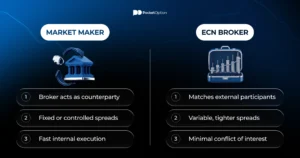
Market Makers vs ECN Brokers and No Dealing Desk Models
Broker models differ significantly in how orders get filled. In crypto, the same dynamics apply. Understanding what is a market maker in crypto versus a traditional order-book exchange helps you evaluate execution quality and cost structure across different platforms.
| Feature | Market Maker | ECN Broker | No Dealing Desk (NDD) |
|---|---|---|---|
| Who takes your trade | The broker itself | Other market participants | External liquidity providers |
| Spread type | Fixed or broker-controlled | Variable, often tighter | Variable, liquidity-dependent |
| Conflict of interest | Possible, broker is counterparty | Minimal, commission only | Low, broker routes orders only |
| Execution | Fast internal fill | Fast, depends on matching | Straight-through processing |
| Best suited for | Beginners, small accounts | Active traders, scalpers | Traders wanting transparency |
| Typical cost | Spread built into price | Tight spread plus commission | Spread, sometimes plus commission |
In decentralized crypto markets, automated protocols replace human firms entirely. Liquidity pools on platforms like Uniswap set prices via automated market maker (AMM) formulas based on asset ratios in the pool. Knowing what is a market maker in crypto across both CEX and DeFi environments matters when you operate in both, since execution dynamics differ significantly.
Who Are the Major Market Makers?
Who are the market makers in traditional finance? In equities, Citadel Securities, Virtu Financial, Jane Street, and IMC Trading dominate. On NYSE, designated firms carry formal obligations to maintain orderly trading in specific securities.
In forex, the biggest names are major global banks: JPMorgan, Deutsche Bank, Citi, and Barclays, quoting institutional-size prices around the clock. Retail brokers redistribute that liquidity to their clients, often operating as intermediaries at the retail tier.
In crypto, Wintermute, Cumberland, and Jump Crypto handle institutional liquidity on centralized exchanges. On DeFi protocols, participants who deposit assets into AMM pools function as the collective equivalent, earning fees in exchange for providing depth to the protocol.
Advantages and Disadvantages
Trading through this type of broker setup comes with genuine benefits and real trade-offs. Here is an honest breakdown.
Advantages:
- Always-available liquidity: Orders execute immediately, even in low-volume sessions or off-peak hours.
- Predictable costs: Fixed spreads make transaction costs easy to plan around.
- Lower entry barriers: These brokers typically accept smaller deposits than institutional ECN setups.
- Simplified pricing: One cost visible in the quote, no separate commission line to track.
Disadvantages:
- Structural conflict of interest: When the broker is your counterparty, their gain is sometimes your loss. Regulated brokers manage this through hedging, but the tension is built into the model.
- Requotes in fast markets: Some firms reject orders at the quoted price during volatility, offering a revised quote instead, which slows fills at the worst possible time.
- Spread widening: During major news releases or thin liquidity windows, quotes can expand sharply, increasing your effective transaction cost.
- Less price transparency: You rarely see where your order goes or how your fill compares to the broader institutional market.
Risk Disclaimer: Trading involves significant risk of capital loss. This article is for educational purposes only and does not constitute financial advice. Always conduct independent research and consider your risk tolerance before making any trading decisions.
FAQ
What Is a Market Maker in Crypto?
In crypto, a market maker is an entity that continuously posts buy and sell quotes on an exchange, so trades can execute without waiting for a natural counterparty. On centralized exchanges, professional firms like Wintermute or Cumberland maintain order book depth on both sides. On decentralized exchanges, automated protocols use algorithmic liquidity pools where participants deposit paired assets and prices are set by AMM formulas rather than individual humans. Both approaches solve the same core problem: a tradeable price is always available, regardless of whether another participant wants the opposite side at that moment.
Are Market Makers Good or Bad for Traders?
The honest answer: it depends on the broker. These firms provide real value, including instant execution, consistent availability, and accessible entry for smaller accounts. The concern arises when a broker acting in this role has poor risk management or operates under light regulation, creating incentives to trade against clients rather than hedge exposure. A well-run operation profits from spread volume and efficient flow internalization, not from client losses. Evaluate regulation and execution quality first, then consider the business model.
What Is the Difference Between a Market Maker and an ECN Broker?
The core difference in the ecn brokers vs market makers no dealing desk comparison is who takes the other side of your trade. With a firm operating as counterparty, your order gets absorbed internally and the net position is hedged. With an ECN broker, your order enters a network of external liquidity providers and the broker earns a commission rather than a spread markup. ECN typically offers tighter raw spreads but adds a per-trade commission. Execution quality with ECN depends on available matching liquidity; with the counterparty model, it depends on the broker's internal pricing and risk management practices.
About the author :
Trading Strategies
Sign up for more like this
Customize your newsfeed with content you're actually interested in — get up-to-date personalized newsletter in your inbox.

Your comment
Comments are pre-moderated to ensure they comply with our blog guidelines.